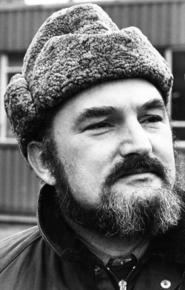
Born in 1925, Alan Brien is a novelist,
journalist and critic of distinction. Serving as
an air-gunner in the RAF in the War, he
enjoyed a long and successful career in Fleet
Street, writing variously for the Daily Mail,
the Sunday Dispatch, Sunday Pictorial,
Sunday Telegraph, Spectator, New Statesman,
Sunday Times, Evening Standard, Punch, as
well as being a regular broadcaster on radio
and television. In 1987, his novel on Lenin
was published. Now retired, Alan lives in
North London.
Bless My Soul
by Alan Brien
(“Sacred Cows”, Sunday Times Magazine, 3rd April 1977)
If there is any creature I find less
sympathetic than a sacred cow, it is the
sacred cowherd. And this, it seems to me, is
Malcolm Muggeridge’s true role.
Our sacred cows in the West, like living
goddesses of Nepal, are quite often more to be
pitied than resented. It can be very lonely, rather
tiring and frustrating, above all, being above all,
not much fun up there on the pedestal. Yon are
never allowed to be fallible, gullible, irritable or
wrong. But the cowherd, working on his
percentage, can always plead that he is only
human. He is just the front man for a mystery that
cannot be approached direct. So every guru has
his chila, every champ his manager, every star his
agent, every freak his barker, every gangster his
mouthpiece and the perennial aim of the power
behind the throne is to outlast the power behind
the throne. Our hero, MM, has survived in the
same way by herding many a sacred beast to the
sacrifice without singeing even much more than
his own eyebrows.
The voice is the voice of Malcolm, the
mug is the mug of the Mugg, but the message
must always be the message of the Lord. Now it is
the Lord God, but it has been the Lord Camrose,
also General-Secretary Joseph Stalin, also the
Manchester Guardian, also Mr Punch, also the
BBC. Malcolm Muggeridge is a cowherd for all
seasons – he must never be blamed personally for
where his sacred cow of the decade leaves its
sacred cow pats.
There is no problem charting
Muggeridge’s succession of causes. Indeed, he
has documented the primrose path in his own
volumes of autobiography. He likes to identify his
own part in life’s soap opera as increasingly that
of “a displaced person”. I would substitute instead
“a born defector”, or perhaps “the natural doubleagent”.
The difference is not always easy to detect
as Muggeridge, who also occasionally likes to
present himself as a sometime secret-service man,
has good reason to know.
The pattern, as I see it, is of an eloquent
advocate – a word spinner and jest-juggler
without peer among advertising copywriters –
who too easily becomes imprinted by the allembracing
gospel he is asked to preach, then
equally suddenly rejects the imprint, only to
emboss upon his psyche another monolithic creed.
After each failure the revulsion is dramatic,
permanent, possibly near hysterical.
For example, as a young man he wrote
leaders for the Manchester Guardian, full of
simple faith in progress, the classic doctrine of
liberalism. Even 40 years later he is still
denouncing that innocent idealism in terms of
manic hyperbole: “Liberalism [he wrote in 1965]
will be seen as the great destructive force of our
time: much more so than Communism, Fascism,
Nazism or any other lunatic creeds .... Compared
to the long-term consequences of Gilbert Murray,
Bertrand Russell and Mrs Eleanor Roosevelt,
Hitler was an ineffective dreamer, Stalin a Father
Christmas and Mussolini an Arcadian shepherd.”
He went to Moscow in the mid-1930’s,
anticipating the foundation of Utopia, and
prepared to sell up and settle there forever.
Disillusioned, he has never ceased denouncing
everyone on the Left, even those who never
shared his naive expectations, as dupes of the
Kremlin. After the war he wrote leaders for the
Telegraph as assistant editor, and it is the Tory
leaders he supported then he now places in the
pillory. He came to fame as a combative, critical
Editor of Punch – a magazine he has since rarely
missed an opportunity of denigrating. And he
finally established himself as a household image
on television, with his knobkerrie face and that
strangulated voice which, next to Edward Heath’s,
must be the most extraordinary and artificial of
any public man. Yet his favourite topic is a
denunciation of TV as a medium fit only for
hucksters and charlatans, guaranteed to process
reality into trivia.
For an intellectual of his repute, many of
his essays are curiously ill-informed, selfcontradictory
or just plain silly, better fitted for
the Sunday Express than the Guardian or the
Statesman, or even the Telegraph, despite a
surface glitter of sequinned rhetoric. The
quotation on liberalism is one standing for many.
Muggeridge on contraception and abortion, with
he loathes with a virulence which seems barely
rational, will seize any stick, however feeble and
rotten.
________________________________________________________________________________
Friday, 13 June 2008


'Narcissus revisited' grooming by Alan Brien
Alan was fitted for a suit in Savile Row in the Sixties (the date appears inside the jacket)which he was still wearing fifty years on, the last time was at Becky's wedding.
Men in Vogue
Condé Nast. November 1965-1970?
Associate editors were Robert Harling and Beatrix Miller of this fashion and lifestyle men's magazine. The cover of the first issue showed actor Edward Fox in a fur coat photographed by Norman Parkinson. It had 126 pages plus cover. Size: 12.25" x 9.125" (31cm x 23cm). It lasted at least until the winter of 1969.
Condé Nast drew back from launching Men in Vogue as an autonomous publication again in 1985, when Cosmopolitan, Elle and Harpers & Queen all had dedicated sections for men. It was not until 2005 that Men's Vogue appeared.
Contents of the first issue of Men in Vogue in 1965:
'A reference for Mellors': author Anthony Powell considered what happened to Lady Chatterley and her lover
extract from jazz man George Melly's biography, Owning Up
'The Englishman: the best dressed man in the world?' Featured James Astor, Cecil Beaton, Brinsley Black, Gay Kindersley, Nigel Lawson (BBC economics adviser and FT columnist), Jocelyn Stevens (editor-in-chief of Queen), Sir Fitzroy Maclean (a Scot), Christopher Gibbs, Lord Gormanston, Julian Ormsby-Gore
'The heroes of St Moritz': Tony Nash and Robin Dixon had won the world bobsleigh championship. Photographs by Terence Donovan
'The most Bailey girls in the world.' David Bailey on women he finds 'different, mysterious and interesting': Catherine Deneuve (his wife); Jean Shrimpton; Monica Vitti; Francoise Dorleac; Jeanne Moreau; Sue Murray
'Men and their cars': racing driver Jim Clark in a Lotus Elan; photographer Terence Donovan in a Silver Cloud II; Mark Boxer, editorial director of London Life, in a Rover 2000; Kevin Powell, Granada traines (Mini Moke); Peter Sheridan (Invicta 1930); Lord Snowdon (Mini and Aston Martin DB5);
'But you can get a girl with a gun' by Antonia Fraser
special report on winter clothes (cover feature). The models were all actors: Corin Redgrave, Edward Fox and Gilles Milinaire
'Ski and after'
Paris
'Narcissus revisited' grooming by Alan Brien
'What is travelling?': adventure, sport, business and travelling's sake
Christopher Gibbs' shopping guide to London
fashion award for 1965: worst-dressed man award for prime minister Harold Wilson
Men in Vogue
Condé Nast. November 1965-1970?
Associate editors were Robert Harling and Beatrix Miller of this fashion and lifestyle men's magazine. The cover of the first issue showed actor Edward Fox in a fur coat photographed by Norman Parkinson. It had 126 pages plus cover. Size: 12.25" x 9.125" (31cm x 23cm). It lasted at least until the winter of 1969.
Condé Nast drew back from launching Men in Vogue as an autonomous publication again in 1985, when Cosmopolitan, Elle and Harpers & Queen all had dedicated sections for men. It was not until 2005 that Men's Vogue appeared.
Contents of the first issue of Men in Vogue in 1965:
'A reference for Mellors': author Anthony Powell considered what happened to Lady Chatterley and her lover
extract from jazz man George Melly's biography, Owning Up
'The Englishman: the best dressed man in the world?' Featured James Astor, Cecil Beaton, Brinsley Black, Gay Kindersley, Nigel Lawson (BBC economics adviser and FT columnist), Jocelyn Stevens (editor-in-chief of Queen), Sir Fitzroy Maclean (a Scot), Christopher Gibbs, Lord Gormanston, Julian Ormsby-Gore
'The heroes of St Moritz': Tony Nash and Robin Dixon had won the world bobsleigh championship. Photographs by Terence Donovan
'The most Bailey girls in the world.' David Bailey on women he finds 'different, mysterious and interesting': Catherine Deneuve (his wife); Jean Shrimpton; Monica Vitti; Francoise Dorleac; Jeanne Moreau; Sue Murray
'Men and their cars': racing driver Jim Clark in a Lotus Elan; photographer Terence Donovan in a Silver Cloud II; Mark Boxer, editorial director of London Life, in a Rover 2000; Kevin Powell, Granada traines (Mini Moke); Peter Sheridan (Invicta 1930); Lord Snowdon (Mini and Aston Martin DB5);
'But you can get a girl with a gun' by Antonia Fraser
special report on winter clothes (cover feature). The models were all actors: Corin Redgrave, Edward Fox and Gilles Milinaire
'Ski and after'
Paris
'Narcissus revisited' grooming by Alan Brien
'What is travelling?': adventure, sport, business and travelling's sake
Christopher Gibbs' shopping guide to London
fashion award for 1965: worst-dressed man award for prime minister Harold Wilson
Bryn Mawr Classical Review 03.05.24
Alan's second novel, working title, 'And When Rome Falls', was based on reading around the life of Cicero and commissioned by David Godwin when an Editor at Jonathan Cape. It was very close to completion.
Alan was a member of the Society for the Promotion of Roman Studies.
Bryn Mawr Classical Review 03.05.24
Letter: More New Books with Ancient Settings
For some previous titles, cf. BMCR 3.4 (1992), 338. The most gorgeous new item is Roman Nights (St Martin's Press, NY, 1991), a novel by one Ron Burns, billed in the blurb as a UPI editor, Philadelphia Bulletin columnist, Los Angeles Herald Examiner crime reporter, and (now) novelist. His story is set between the last days of Marcus Aurelius and the murders of Commodus, then Pertinax. The protagonist functioning as privatus dickus is Livinius Severus, a minor noble, lawyer, and Stoic. His job is to solve a series of gruesome murders of Stoics, a nice thought (the murders, that is, not the solving). Lucan and Thrasea turn up as Stoics. So do characters with odd names, e.g., Cinna Catalus (sic). Most deliciously for devotees of the Petronian question, so do Trimalchio (as mine host, with some pastiche and filchings from the Cena) and 'his whore' Fortunata, with whom our hero has some jolly times, including one night of five couplings -- penile servitude, indeed! There is much quoting of Marcus Aurelius' 'just published' Meditations, and at one stage 8 rolls of papyrus are found containing Juvenal's Satires, with copious 'dirty' quotation from the sixth.
In France, Pierre Grimal has just brought out Les Memoires d'Agrippine (de Fallois, Paris, 1992), a fictional recreation of one of the most regrettably lost ancient documents of them all, the Memoirs of Nero's mum, whose doings would eclipse those of Fergie and Diana. So far, I've only seen the review in Le Canard Enchaine (5/8/92), but it sounds yummy. Incidentally, anyone visiting England in the near future might still be able to see a rare performance of Handel's early (1709) opera, Agrippina, with American soprana Susan Roberts in the title role -- one reviewer compared her to Bette Davis.
Falco is back, in Lindsey Davis' The Iron Hand of Mars (Hutchinson, London, 1992: I imagine there is an American edition), this time sleuthing in Germany, sent by Vespasian to look into the fates of Civilis and the XIVth Legion, with flashbacks to the hapless Quintilius Varus. Women play a big role in this new adventure.
Those more attracted to Greek settings may like A Choice of Murder (Owen, London, 1992) by Peter Vansittart, a reworking of Plutarch's account of Timoleon, suitably embellished to make a proper novel.
A mammoth new novel on Augustus is scheduled to appear later this year by Alan Brien. This author is a British journalist and humorist who (I suspect) may not be well known in North America, but Calgary libraries (not likely to be unique in this) contain his earlier titan, a novel about Lenin.
I've saved the bad news until last. The ineffable Colleen McCullough has recently inflicted volume two (The Grass Crown) of her threatened multi-volume saga on the late Republic on to a suffering world. I did my best to kill the thing off while reviewing the inaugural The First Man in Rome in The World & I (March, 1991), 406-12, but who am I to repel this march of Thornbirds in Togas?
Barry Baldwin University of Calgary
Ed.'s note:
As I read this letter, it seemed to me that we got to the bad news pretty early on. Would it be fair to ask whether any of these exercises do more than use Roman costumes to provide cheap thrills, with lashings (painfully evident in this account) of sexism? This series started because I called attention to Saylor's Roman Blood, which seemed to me both a decent murder mystery and a serious attempt to do justice to Cicero's Pro Sexto Roscio Amerino, and though it is a light enough sort of book, I still think it has merit. (Saylor has a new one in the bookstores called Arms of Nemesis, with a Spartacan theme but less closely tied, it would appear, to any specific text, but I've not yet had time to look at it.) Rather like the south central LA murder mysteries of Walter Mosley, who puts a lot of social history between the lines, or the early Tony Hillermans, while he still had fresh things to say about the Navajo.
JO'D 26 September 1992
Alan was a member of the Society for the Promotion of Roman Studies.
Bryn Mawr Classical Review 03.05.24
Letter: More New Books with Ancient Settings
For some previous titles, cf. BMCR 3.4 (1992), 338. The most gorgeous new item is Roman Nights (St Martin's Press, NY, 1991), a novel by one Ron Burns, billed in the blurb as a UPI editor, Philadelphia Bulletin columnist, Los Angeles Herald Examiner crime reporter, and (now) novelist. His story is set between the last days of Marcus Aurelius and the murders of Commodus, then Pertinax. The protagonist functioning as privatus dickus is Livinius Severus, a minor noble, lawyer, and Stoic. His job is to solve a series of gruesome murders of Stoics, a nice thought (the murders, that is, not the solving). Lucan and Thrasea turn up as Stoics. So do characters with odd names, e.g., Cinna Catalus (sic). Most deliciously for devotees of the Petronian question, so do Trimalchio (as mine host, with some pastiche and filchings from the Cena) and 'his whore' Fortunata, with whom our hero has some jolly times, including one night of five couplings -- penile servitude, indeed! There is much quoting of Marcus Aurelius' 'just published' Meditations, and at one stage 8 rolls of papyrus are found containing Juvenal's Satires, with copious 'dirty' quotation from the sixth.
In France, Pierre Grimal has just brought out Les Memoires d'Agrippine (de Fallois, Paris, 1992), a fictional recreation of one of the most regrettably lost ancient documents of them all, the Memoirs of Nero's mum, whose doings would eclipse those of Fergie and Diana. So far, I've only seen the review in Le Canard Enchaine (5/8/92), but it sounds yummy. Incidentally, anyone visiting England in the near future might still be able to see a rare performance of Handel's early (1709) opera, Agrippina, with American soprana Susan Roberts in the title role -- one reviewer compared her to Bette Davis.
Falco is back, in Lindsey Davis' The Iron Hand of Mars (Hutchinson, London, 1992: I imagine there is an American edition), this time sleuthing in Germany, sent by Vespasian to look into the fates of Civilis and the XIVth Legion, with flashbacks to the hapless Quintilius Varus. Women play a big role in this new adventure.
Those more attracted to Greek settings may like A Choice of Murder (Owen, London, 1992) by Peter Vansittart, a reworking of Plutarch's account of Timoleon, suitably embellished to make a proper novel.
A mammoth new novel on Augustus is scheduled to appear later this year by Alan Brien. This author is a British journalist and humorist who (I suspect) may not be well known in North America, but Calgary libraries (not likely to be unique in this) contain his earlier titan, a novel about Lenin.
I've saved the bad news until last. The ineffable Colleen McCullough has recently inflicted volume two (The Grass Crown) of her threatened multi-volume saga on the late Republic on to a suffering world. I did my best to kill the thing off while reviewing the inaugural The First Man in Rome in The World & I (March, 1991), 406-12, but who am I to repel this march of Thornbirds in Togas?
Barry Baldwin University of Calgary
Ed.'s note:
As I read this letter, it seemed to me that we got to the bad news pretty early on. Would it be fair to ask whether any of these exercises do more than use Roman costumes to provide cheap thrills, with lashings (painfully evident in this account) of sexism? This series started because I called attention to Saylor's Roman Blood, which seemed to me both a decent murder mystery and a serious attempt to do justice to Cicero's Pro Sexto Roscio Amerino, and though it is a light enough sort of book, I still think it has merit. (Saylor has a new one in the bookstores called Arms of Nemesis, with a Spartacan theme but less closely tied, it would appear, to any specific text, but I've not yet had time to look at it.) Rather like the south central LA murder mysteries of Walter Mosley, who puts a lot of social history between the lines, or the early Tony Hillermans, while he still had fresh things to say about the Navajo.
JO'D 26 September 1992
Oxford Journals.org Essays in Criticism
You need a subscription to access this but it brings to mind how well read Alan was and the ways in which he disseminated his reading. Who is John?
W. J. HARVEY Editorial CommentaryEssays in Criticism, 1968; XVIII: 1 - 14. ......University College (it was John's) to whom I had recently been introduced by one of my own undergraduate-pupils (was it Alan Brien?), who had also lent me a slim volume of the young man's very promising and elegant poems. John and I chatted briefly......
W. J. HARVEY Editorial CommentaryEssays in Criticism, 1968; XVIII: 1 - 14. ......University College (it was John's) to whom I had recently been introduced by one of my own undergraduate-pupils (was it Alan Brien?), who had also lent me a slim volume of the young man's very promising and elegant poems. John and I chatted briefly......
Thursday, 12 June 2008
Ruskin School of Art, Oxford
Clarifications and amendments will be made. But placing the suggestion, in the first instance, that Alan was a life model at the Ruskin School of Art, when at Oxford, and believed his form appeared in a sculpture commissioned for Westminster Cathedral (can't have been the Abbey, can it?). Clearly he modelled and we did once visit the Conway Library to see if we could find him, to no avail.
http://www.courtauld.ac.uk/research/photographic/conway/index.shtml
http://www.courtauld.ac.uk/research/photographic/conway/index.shtml
Wednesday, 11 June 2008
Peter Wilby The Guardian, Monday June 2 2008 Article history
Remembering Alan Brien
Last week's obituaries of Alan Brien, I thought, didn't quite pinpoint his place in the history of journalism. Brien, as one obituarist said, was a critic and essayist in the tradition of Belloc and Chesterton. He reviewed film, theatre and books when reviewers were among the biggest newspaper stars. Now, the stars are general columnists, writing about life, the universe and everything, but mainly about themselves and their families.
Brien, who died at 83, straddled those two eras, being not only among the last of the old, but also among the first of the new. Harold Evans, when Sunday Times editor, said Brien could get more interesting copy from the fluff in his navel than some hacks could get from a month on the road. Once, when he was driving up the motorway with his wife, the Guardian's Jill Tweedie, a tiny pebble shattered the car windscreen. Between them, I swear, they got six columns out of it. The record probably stands to this day.
Contact the Media editor
editor@mediaguardian.co.uk Report errors or inaccuracies: reader@guardian.co.uk
Letters for publication should be sent to: letters@guardian.co.uk
Last week's obituaries of Alan Brien, I thought, didn't quite pinpoint his place in the history of journalism. Brien, as one obituarist said, was a critic and essayist in the tradition of Belloc and Chesterton. He reviewed film, theatre and books when reviewers were among the biggest newspaper stars. Now, the stars are general columnists, writing about life, the universe and everything, but mainly about themselves and their families.
Brien, who died at 83, straddled those two eras, being not only among the last of the old, but also among the first of the new. Harold Evans, when Sunday Times editor, said Brien could get more interesting copy from the fluff in his navel than some hacks could get from a month on the road. Once, when he was driving up the motorway with his wife, the Guardian's Jill Tweedie, a tiny pebble shattered the car windscreen. Between them, I swear, they got six columns out of it. The record probably stands to this day.
Contact the Media editor
editor@mediaguardian.co.uk Report errors or inaccuracies: reader@guardian.co.uk
Letters for publication should be sent to: letters@guardian.co.uk
Der Teufel
When Alan's boyhood friend, David Maccaby, who became a painter and later blind, took Alan home for the first time, his mother, on opening the front door, reeled back with 'Der Teufel', Satan. The Hebrew term for Satan has a decidely different meaning than in Christianity. It is the title of a Prosecutor at the Divine Court.
Satan, the Devil, Pan....
A link to John Milton's 'Paradise Lost', the book Alan carried with him when flying as a rear air gunner in the Lancaster.
Satan, the Devil, Pan....
A link to John Milton's 'Paradise Lost', the book Alan carried with him when flying as a rear air gunner in the Lancaster.
Subscribe to:
Posts (Atom)